Workout Tracker Printable Template for Every Fitness Goal
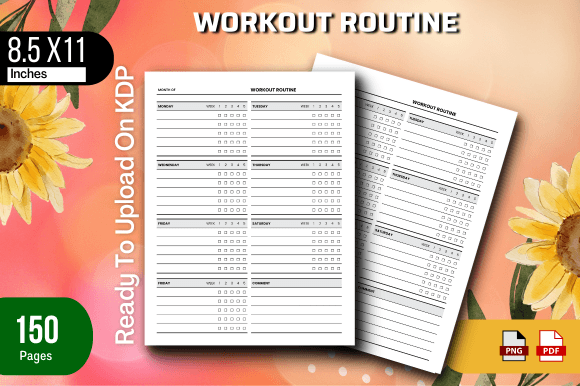
Staying consistent with a fitness routine is rarely about motivation alone — it’s about having a system that makes progress visible. The Workout Tracker Printable Template is exactly that kind of system. It’s a clean, no-fuss design asset that lets you record training focus, cardio details, exercise sets, and personal notes all on one well-organized page. Whether you’re printing a single sheet to stick on the fridge or building an entire planner interior for a commercial project, this template bridges the gap between intention and action without any design friction.
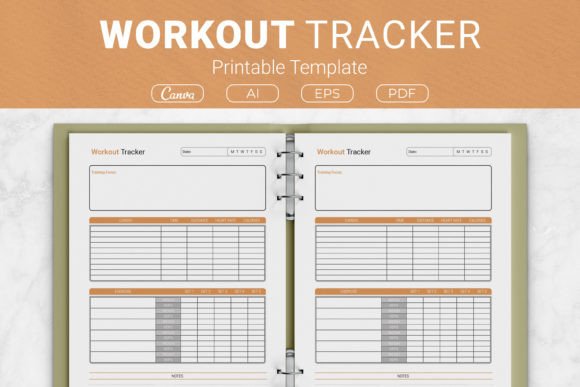
At first glance, the tracker feels approachable rather than overwhelming. The layout uses a modern sans serif font that keeps everything legible at small sizes — exactly what you need when you’re glancing at a page between sets. The visual hierarchy is subtle but effective: training focus sits at the top as a quick checkbox trio (cardio, strength, or both), then the tracker flows into dedicated cardio and strength sections. A generous notes area rounds out the bottom, giving you room for off-the-cuff reflections. It’s the kind of understated modern typography and spacing that designers instinctively appreciate, while non-designers just notice it’s “easy on the eyes.”
Why a Simple Workout Log Changes Everything
Fitness apps are great until a notification pulls you away mid-set, or you find yourself scrolling instead of recording. Paper-based tracking — especially when it’s well-designed — removes that friction. The Workout Tracker Printable Template puts your entire session on one surface, free from distractions. You can circle “strength” or “cardio,” jot down your treadmill distance and heart rate, then move to the exercise grid where weight and reps become a visible story over time.
That visual story matters. When you flip back through a binder, you see trends no app summary captures: the week you added five pounds to every lift, the month your resting heart rate dropped, the notes where you wrote “felt strong today.” A clean printable template turns that data into something you can touch, highlight, and revisit — which psychologists know reinforces habit formation. Add it to a fitness journal, a bullet journal, or a personal planner, and you’ll build a record that’s uniquely yours.
Cardio and Strength Tracking in One Clean Layout
Many workout logs focus on either lifting or running. This template deliberately bridges both. The cardio section asks for time, distance, heart rate, and calories burned — four data points that give a rounded picture of any aerobic session. The exercise section uses a straightforward table: exercise name, weight, and reps. You can log compound lifts, isolation moves, bodyweight circuits, or kettlebell flows without rewriting the template. That versatility makes it a smart choice for hybrid athletes, HIIT enthusiasts, and anyone whose “leg day” also includes a rowing machine.
What makes the template feel professional is how these sections are spaced. There’s enough breathing room to write comfortably, even with slightly larger handwriting. The headers use a slightly bolder weight from the same type family — a simple sans serif font pairing that creates clear separation without needing decorative elements. For those who eventually customize the file in Canva or Illustrator, the base typography is easy to swap for a script font or a serif font to match a specific brand identity, but the default is genuinely print-ready and universally readable.
From Home Binder to KDP Interior: Who Benefits Most
The beauty of a well-structured template is how it travels across different contexts. For personal use, it’s a no-brainer: print it at home, hole-punch it, and keep a fitness section in a family planner or a personal binder. Many customers also use the US Letter and A4 sizes to create a consistent look across their entire notebook setup. The smaller 7.5 x 9.25 inch and 6×9 inch formats fit perfectly into compact planners, travel journals, or even a gym bag clipboard.
For creative professionals — designers, publishers, Etsy sellers, content creators — the commercial potential is where the file format choices shine. The package includes open-source AI Illustrator files, an EPS, print-ready PDFs, and a link to Canva templates. That means you can open the design, tweak colors or fonts, add your logo, and output a finished interior for a Kindle Direct Publishing (KDP) fitness journal. Because the template wasn’t built on a fussy, decorative display font or an ultra-thin script font, the base files are easy to adapt while maintaining readability when printed at scale. This isn’t just a printable; it’s a flexible design asset with real commercial legs.
The Typography Behind the Professional Feel
Even though most users won’t consciously analyze the type choices, they absolutely feel them. The template’s primary typeface is a geometric-leaning sans serif with open apertures and a steady rhythm — exactly the kind of creative font that supports quick data entry. In fitness tracking, numbers are as important as words, and numeric characters stay distinct at small point sizes. There’s no confusion between a “5” and a “6” when you’re sweating and writing fast. That’s the mark of a thoughtful type selection, whether the original designer realized it or not.
For anyone who customizes the Canva version, the template becomes a playground for font pairing. Maybe you keep the headers in that clean sans serif and swap the notes section to a gentle handwritten font that makes journaling feel more personal. Or you introduce a sturdy serif font for the exercise names to add a sense of durability and tradition — a subtle nod to old-school strength training logs. The key is that the starting point is already strong. You’re not rescuing a broken layout; you’re enhancing one that’s already balanced.
Practical Guidance for Choosing and Customizing the Template
Before you download, think about how the template will live in your workflow. If you’re a solo fitness enthusiast, the PDFs and pre-sized formats are plug-and-play. Print a week’s worth, staple them, and go. If you plan to brand this for a business or publish on KDP, consider opening the Illustrator or EPS files first. Check the layer structure: well-organized templates separate tables, headers, and decorative elements so you can adjust colors without affecting the entire sheet. The open-source AI files invite that kind of customization without licensing headaches.
When evaluating whether the template fits a bigger project, ask yourself: does this layout support a variety of workout styles without becoming cluttered? Here, the answer is a clear yes. The training focus checkboxes mean it’s equally at home in a yoga journal (just cardio, maybe) and a powerlifting log (strength all the way). The exercise grid doesn’t assume a fixed number of sets; it gives you rows to fill as needed. This flexibility is invaluable for creating a publishing template that appeals to a wide audience, which is essential for KDP authors and stationery brand owners.
Readability, Visual Hierarchy, and Real-World Use
Let’s talk about real-world use: you’re in a dimly lit garage gym. Your phone is dead. You need to log your front squats and then move to a conditioning circuit. The template’s visual hierarchy — built entirely through type scale and white space, not intrusive graphics — guides your eye from the top “Training Focus” down to the grid. The cardio section uses subtle horizontal rules to separate the four metrics, so even in low light, you won’t record your distance in the heart rate line. This is the kind of understated web design principle that translates beautifully to print, and it’s one reason the template feels so much more polished than a hand-drawn log.
For marketers and brand strategists, consider how this printable could become a low-cost lead magnet. A fitness coach might offer a branded version — with a logo and a custom display font for headers — as a free download in exchange for an email. A wellness blogger could bundle it into a digital resource library. The brand identity remains consistent because the template’s bones are solid, and the customization options don’t break the layout. Pair it with a matching meal planner or habit tracker, and you’ve got a cohesive lookbook that screams professionalism.
Commercial Licensing and Creative Freedom
One of the most overlooked aspects of using printable templates commercially is licensing clarity. The package description explicitly positions the Workout Tracker Printable Template as KDP-ready and ideal for personal or small business use. If you plan to sell printed copies or include the template in a paid digital product, confirm the commercial terms — many open-source Illustrator files come with a standard commercial license, but always verify usage rights for derivative works. When you’re building a product line around design assets like this, clear licensing protects your business and keeps everything above board.
From a creative workflow standpoint, having illustrator, EPS, and Canva access under one roof saves hours. You can rough out designs in Canva, then hand off the EPS to a print partner for high-resolution output. This multi-format package is particularly valuable for small business owners who juggle multiple roles: you need the speed of digital mockups but the precision of vector editing. The template’s consistent use of a single type family across sections also simplifies font pairing — you don’t need to hunt for complementary fonts to achieve a pulled-together look. It’s already done.
Making the Template Part of a Larger Fitness System
Think beyond a single sheet. Many users combine this tracker with a cover page, a goal-setting worksheet, and a monthly progress chart to create a full fitness planner. The multiple size options make it easy to nest the tracker inside a binder alongside other printables. In the 6×9 format, it slips into a purse or gym duffel without crunching corners. The A4 size aligns with international standard notebooks, which matters if your audience isn’t US-based. This global-friendly approach is something experienced publishers instinctively seek out.
If you’re designing for a brand, remember that fitness culture thrives on visual cues. A powerlifting brand might overlay the template with gritty, industrial textures and a bold display font for the title. A yoga studio could soften the palette and introduce a flowing script font for the notes header. Because the underlying structure is a neutral grid, it recedes and lets those brand-specific touches shine. This is exactly what makes a well-made template so valuable: it’s a chameleon that lifts your design work rather than competing with it.
Ultimately, the Workout Tracker Printable Template succeeds because it respects both the user and the designer. It doesn’t try to be a motivational poster or an over-engineered dashboard. It’s a piece of paper waiting for you to fill it, structured enough to keep you on track and open enough to let you make it your own. For anyone building a personal fitness library or a commercial product line, that balance is rare and genuinely useful.