Understanding the Difference Between Rational and Irrational Anxiety and How a Structured Journal Can Help
Anxiety does not arrive with a clear label. It can feel the same whether the trigger is a real looming deadline or a vague sense that something terrible might happen. One of the most practical distinctions mental health professionals teach is the difference between rational and irrational anxiety. A Rational Vs. Irrational Anxiety Journal is a resource designed to help individuals map out that difference on paper. Rather than offering generic prompts, this type of workbook guides users through identifying which worries are tied to identifiable, solvable problems and which ones stem from distorted thinking patterns.
For adults managing daily stress, relationship concerns, career uncertainty, or general unease, the act of writing can slow down a racing mind. But not all anxiety journals are built for the same purpose. Some focus on gratitude, others on tracking symptoms. A journal that specifically separates rational from irrational anxiety adds a layer of cognitive evaluation that many other formats leave out. Understanding what makes this approach distinct, what cognitive distortions it targets, and when it fits best can help readers decide if this resource aligns with their needs.
What Defines a Rational Vs. Irrational Anxiety Journal
At its core, this journal format is built around one central question: Is this worry based on a fact or a feeling? Rational anxiety responds to an actual event or a probable outcome — a job interview, a medical test, an important conversation. Irrational anxiety tends to magnify unlikely scenarios, catastrophize outcomes, or attach to things far outside a person's control.
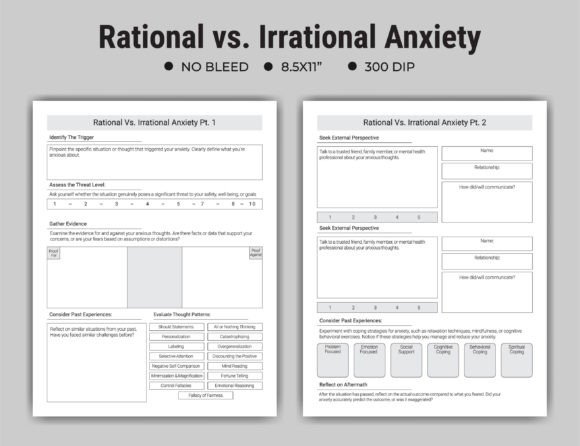
A typical page in a Rational Vs. Irrational Anxiety Journal provides space to name the situation, describe the automatic thought, rate the intensity of the feeling, and then examine the evidence. From there, the user can categorize the anxiety as rational or irrational. If rational, the next step often involves problem-solving. If irrational, the process shifts toward identifying the cognitive distortion at play. This back-and-forth between analysis and reflection is what gives the journal its name and its structure.
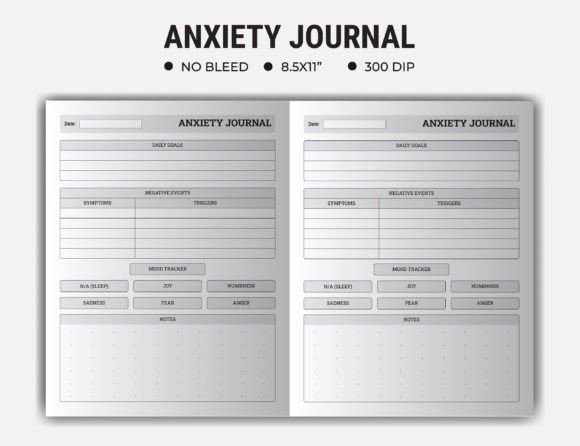
The interior design matters here. A 120-page workbook gives enough room to track patterns over weeks or months. At 8.5 by 11 inches, the full-size format offers ample writing space without feeling cramped — something smaller notebooks or phone apps cannot always provide. Because the pages are print-ready with no bleed, they translate cleanly into physical use, which matters for a tool meant to slow down thinking, not accelerate it.
How Cognitive Distortions Fit Into the Picture
Irrational anxiety rarely exists without an accompanying cognitive distortion. These are predictable mental shortcuts or exaggerated thought patterns that skew perception. Common distortions include catastrophizing, mind reading, black-and-white thinking, overgeneralization, and emotional reasoning. A well-crafted Rational Vs. Irrational Anxiety Journal often includes brief explanations or checklists of these distortions so users can name what they are experiencing.
For example, someone who sends an email and does not receive a reply within an hour might think, "They are ignoring me. I probably said something wrong. They must be angry." That thought feels urgent and real. Writing it out and checking it against a list of distortions might reveal mind reading and catastrophizing. The journal becomes a space to notice that pattern and begin challenging it, rather than accepting the emotional reaction as truth.
Some mental health worksheets tackle distortions in isolation. Others focus purely on coping skills. The value of a journal that integrates cognitive work into the flow of daily reflection is that it does not treat anxiety as a monolith. It encourages nuance — and that nuance is often what helps people step out of an anxious spiral.
Comparing This Format to Other Anxiety Tools and Approaches
Anxiety management tools fall into several broad categories. There are open-ended notebooks where people simply write whatever comes to mind. There are guided gratitude journals and habit trackers. There are therapist-created digital apps with push notifications and mood graphs. And then there are structured cognitive-behavioral worksheets, either in standalone sheets or compiled into larger workbooks.
The Rational Vs. Irrational Anxiety Journal occupies a space somewhere between a full CBT workbook and a freeform diary. It is structured enough to guide thinking, but not so dense that it feels clinical. Compared to apps, it offers privacy and a slower pace. Compared to open-ended journaling, it gives more direction. For someone who has tried writing in a blank notebook and felt stuck, the framework can be a welcome alternative. For someone accustomed to automated mood tracking, the manual effort of writing may feel more intentional and less passive.
One tradeoff worth noting is that this style of journal works best for people who are willing to engage with their thoughts in writing. It is not a passive solution. If a person is currently in a state of acute panic or crisis, the rational-versus-irrational analysis might be difficult to complete without support. That does not make the journal ineffective — it simply means it is a better fit for reflective, day-to-day use than for immediate intervention during a severe episode.
Strengths, Limitations, and Practical Use Cases
A systematic approach to separating rational from irrational anxiety builds a skill that extends beyond the pages. Regular users often report that over time, they begin doing the cognitive check mentally. The journal trains a habit of questioning automatic thoughts before acting on them. For people with generalized anxiety, social anxiety, or work-related stress, that skill can make daily life feel less reactive.
The page count is a practical consideration. At 120 pages, the journal provides enough structure to establish a routine — potentially several months of consistent use — without being overwhelming. The 8.5 by 11-inch size creates a sense of openness. Compared to compact formats, a larger page can feel less restrictive, which matters when someone needs to untangle complicated thoughts.
Limitations exist. This type of journal is not a diagnostic tool, nor does it replace therapy. It is not designed to treat panic disorders on its own or to serve as a crisis resource. Individuals who struggle with severe avoidance or dissociation may need a different entry point before engaging with cognitive work. However, for someone who has been in therapy and is looking for a reinforcing daily practice, or for someone exploring self-directed mental health work between sessions, the format can be a strong structural support.
When a Cognitive-Focused Journal Makes More Sense Than General Alternatives
If someone primarily needs to vent, a simple blank journal or a voice memo might serve better. If someone needs to rebuild a sense of joy or appreciation, a gratitude journal could be the right choice. But if the core issue involves a constant hum of worry that distorts thinking and makes small problems feel catastrophic, then a journal built around cognitive evaluation offers something those other tools do not: a framework for challenging the thought, not just acknowledging it.
Consider a person who wakes up each morning with a sense of dread but cannot pinpoint why. A blank journal might lead to looping ruminations. A gratitude journal might feel invalidating. A Rational Vs. Irrational Anxiety Journal would instead guide that person to examine what triggered the dread, whether the trigger matches the intensity of the feeling, and whether any cognitive distortions are present. The process focuses on understanding, not bypassing. Over time, that understanding often reduces the power of the anxious response.
Understanding Cognitive Patterns Through Repeated Practice
One of the underrated aspects of a journal like this is the record it creates. Looking back over several weeks of entries can reveal themes that are not obvious in the moment. A person might notice that irrational anxiety most often appears on Sunday evenings, or that certain types of work communication trigger catastrophizing. These patterns become visible through the consistent categorization of rational and irrational thoughts, and they can inform longer-term strategies for managing anxiety triggers.
Mental health worksheets that come as individual pages can serve a similar purpose, but a bound collection keeps everything in one place. The continuity matters. It turns a scattered set of exercises into a cohesive record that reflects progress, plateaus, and shifts over time. For therapists, clients who use this type of journal can bring richer material to sessions, showing not just that they felt anxious but what they did with those feelings and where they got stuck.
Making an Informed Choice for Your Needs
Deciding whether this resource fits comes down to a few honest questions. Do you find yourself caught in repetitive, fearful thinking that does not match the facts of a situation? Are you willing to spend ten to fifteen minutes writing and working through a structured reflection? Do you prefer a tangible, page-based tool rather than a digital interface? If so, the Rational Vs. Irrational Anxiety Journal may align well with your current needs.
If, instead, you are looking for a lightweight daily check-in or a purely emotional outlet without cognitive analysis, you might benefit more from a simpler format. There is no single right tool for everyone. What makes this journal distinct is its emphasis on discernment — teaching the brain to distinguish between a problem that needs solving and a fear that needs challenging. That distinction is a cornerstone of many therapeutic approaches, and having a dedicated space to practice it can accelerate progress.
For adults who self-publish or distribute mental health resources, the technical specifications also matter. The 300 dpi resolution ensures clean, professional printing without blur or pixelation. The no-bleed interior simplifies formatting for print-on-demand platforms. At 8.5 by 11 inches, the trim size is familiar and compatible with standard home printers as well as commercial print providers. These details affect usability, and for a workbook that users will write in by hand, the quality of the printed page can influence the overall experience.
Ultimately, managing anxiety is not about eliminating worry entirely — that is not a realistic goal for most people. It is about building a better filter. A journal that asks, "Is this rational?" with every entry does not promise a life free from anxiety. What it offers is practice in discernment, and over time, that practice can change the way anxiety feels when it shows up.