Client Map, Treatment Planning Tool: A Blueprint for Personalized Care and Lasting Change
Effective therapeutic work demands more than intuition and empathy. It requires a structured yet flexible system that captures a client’s story, tracks evolving goals, and documents the subtle shifts that mark real progress. Many practitioners rely on a patchwork of digital templates, sticky notes, and fragmented records—methods that often break down precisely when clarity matters most. The Client Map, Treatment Planning Tool enters this space as a purpose-built resource: a full 120‑page interior that blends goal setting, collaborative mapping, and progress evaluation into one cohesive document. Designed as a high‑resolution, print‑ready PDF and JPG set, the tool aligns with the growing preference for tangible planning instruments that support both face‑to‑face sessions and reflective solo work.
What sets this resource apart is its dual identity. For the therapist, counselor, coach, or wellness practitioner, it is a clinical ally—organizing case information, treatment objectives, and session milestones without the cold feel of generic hospital forms. For the KDP creator or private practice owner who wants a branded client notebook, it arrives tested on Amazon’s platform, formatted for an 8.5″ × 11″ page with no bleed, and ready to upload. This intersection of professional function and publishing practicality makes the Client Map a relevant response to modern care coordination challenges and the rising demand for high‑quality, low‑content books in the health and self‑improvement space.
The Shifting Landscape of Client Documentation and Therapist Resources
Over the past five years, the way health and wellness professionals approach record‑keeping has evolved noticeably. The pandemic accelerated the adoption of telehealth, but it also revealed the limitations of purely digital ecosystems. Clinicians discovered that screen‑fatigued clients often engage more deeply when a session incorporates a physical tool—a printed worksheet, a shared journal page, or a tangible progress chart. At the same time, tightening insurance requirements and an outcomes‑focused culture have raised the bar for systematic progress evaluation and intervention justification. The Client Map, Treatment Planning Tool meets both needs: it is a thoroughly organized paper‑based companion that can live alongside an electronic health record, serve as a standalone intake system, or become a signature offering in a private practice.
There is also a broader market shift at play. Self‑publishing platforms like Amazon KDP have democratized the creation of professional templates, log books, and planners. Healthcare niches—once dominated by large publishers—now welcome independent designers who understand exactly what a practitioner requires. The Client Map capitalizes on this trend. Its interior is not a generic diary with a medical-themed cover; it is a carefully scaffolded planning tool with dedicated sections for initial assessment, goal clarification, progress notes, and outcomes review. Every page reflects an understanding of clinical workflow, making it a valuable therapist resource that reduces the mental load of form design.
Unpacking the Interior: Structure Meets Flexibility
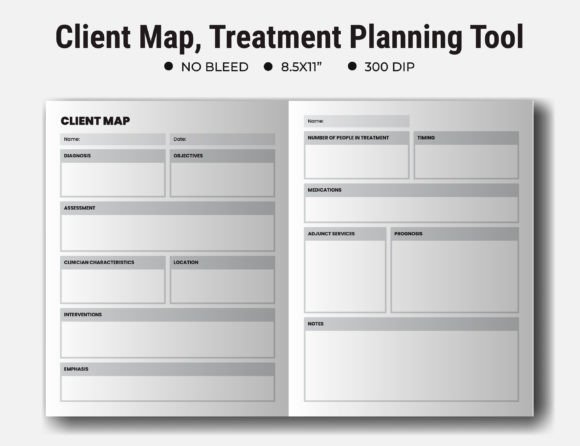
The 120‑page volume offers a considered balance between guided input and open space. While rigid templates can stifle a practitioner’s style, completely blank notebooks often fail to prompt the critical information that drives effective care. The Client Map resolves this tension by providing consistent frameworks—fields for client demographics, presenting concerns, strengths, and risk factors—while leaving generous room for narrative notes, sketches, and personalized models. The included 2 JPG and 1 PDF files (all at 300 dpi) ensure that the content remains crisp whether printed at home, through a commercial service, or published directly on Amazon. The no‑bleed design further simplifies printing, as pages are ready to be trimmed to the perfect 8.5″ × 11″ without losing any content near the edges.
For practitioners who prefer digital annotation, the PDF can be imported into tablet apps like GoodNotes or Notability, allowing handwritten or typed entries while preserving the original layout. This versatility broadens the tool’s usefulness: a counselor might print a fresh set of client engagement worksheets for each new client, while a life coach uses the same digital file to prepare a workshop handout. The high‑resolution graphics maintain readability at any zoom level, which is not always the case with hastily compiled planner templates.
Treatment Objectives: From Vague Hopes to Clear, Measurable Milestones
One of the most persistent challenges in therapeutic work is defining goals that truly guide the process. A client might say, “I want to feel better,” or “I want less anxiety.” While valid starting points, these statements need translation into concrete, behaviorally anchored objectives if progress is to be recognized and celebrated. The treatment objectives section within the Client Map is structured to scaffold that translation. It prompts the practitioner and client to jointly identify specific, time‑bound targets, note the strategies that will be employed, and set realistic check‑in dates.
This approach aligns with evidence‑based practices that underscore the importance of collaborative goal setting. When a client actively participates in defining what success looks like—and sees those definitions written down in a clean, inviting format—ownership increases. The tool’s design deliberately avoids clinical jargon, instead using plain language that invites conversation. Over time, the objectives pages become a living record of the client’s wellness journey, illuminating patterns that might otherwise be lost in memory.
Integrating Evaluation Without Making It a Chore
Evaluation can feel like paperwork, something done after a session. The Client Map reframes it as an integrated pulse‑check. Short rating scales, reflection prompts, and note sections sit right next to the objectives, so that a quick progress snapshot becomes a natural part of each review. The result is a lightweight yet cumulative assessment that keeps the focus on outcomes rather than administrative busywork. For practices that must report to third‑party payers, this systematic progress evaluation data is invaluable; it turns subjective judgment into a documented narrative of change.
The Collaborative Edge: How a Shared Document Deepens Client Work
Modern therapy increasingly values partnership over prescription. The notion of the all‑knowing clinician handing down a treatment plan from an ivory‑tower office is fading. In its place, we see a movement toward shared decision‑making, where the client’s expertise on their own life is treated as essential. The Client Map supports this shift by being something a therapist and client can literally sit beside and fill out together. When a client sees their words, their goals, and their progress mapped on a clean, well‑designed page, it validates their role as co‑creator of the process.
This client collaboration transforms the tool from a private clinician’s log into a communication bridge. In couples or family work, sections of the planner can be used to capture differing perspectives and find common ground. Visual cues—like shaded progress bars or themed icons for different life domains—make the document feel less sterile, fostering a sense of shared ownership. It is a subtle design decision that shifts the emotional tone of the session, reinforcing the idea that planning is part of the care, not a separate administrative task.
From KDP File to Professional Practice: A Reliable Publishing Asset
For those who see the value in offering branded client tools, the technical specs of the Client Map remove common friction points. Amazon KDP’s print‑on‑demand system is powerful but unforgiving; incorrect trim sizes, low‑resolution images, or intrusive margins can lead to rejected proofs or poor customer reviews. This template arrives fully tested on the platform. The 8.5″ × 11″ dimensions are a standard that fits most home and office printers, and the absence of bleed means there are no surprises at the edges. Creators can upload the files as‑is, make minor customizations to the cover (not included but easily added), and publish within hours. For a private practice looking to raise its profile, a beautifully designed treatment planning tool that carries the practice’s logo instantly communicates professionalism. For a KDP entrepreneur, it represents a market‑ready entry into the booming health and wellness planner niche.
The inclusion of 2 JPGs and 1 PDF offers flexible deployment: the PDF preserves vector‑like clarity for print, while the JPGs can be used for promotional previews, social media posts, or digital downloads. Combined, these assets reduce the time between idea and live listing, a crucial advantage in a fast‑moving self‑publishing environment.
Practical Ways to Weave the Client Map into Daily Workflows
Adopting a new tool is worth the effort only if it genuinely simplifies everyday tasks. Consider a solo practitioner who sees 20 clients a week. Before each session, they can pull the client’s current objective sheet, review the last session’s notes, and enter with a clear focus. During the session, they might jot down breakthroughs or new insights directly onto the reflection page. After, they have a coherent record that requires minimal transcription before filing. Over the course of a quarter, the accumulated pages form a rich progress report that makes supervisory consultation or personal reflection significantly easier.
For group practices or agencies, the consistency of the Client Map format is a hidden superpower. When every clinician uses the same underlying structure for goal setting and evaluation, handoffs become safer, and quality assurance reviews are more consistent. The tool does not enforce a specific therapeutic modality—it works equally well for cognitive‑behavioral planning, motivational interviewing stages, or solution‑focused brief therapy—because its backbone is universal: understanding the person, clarifying direction, and tracking movement.
Why a Well‑Designed Evaluation Tool Elevates Care in 2025 and Beyond
Mental health and wellness fields are under intense pressure to demonstrate value while human connection remains at their core. Regulatory bodies, insurance companies, and informed clients alike now expect transparent care coordination and outcome data. However, the drive for measurability often breeds clunky, checkbox‑heavy instruments that drain the humanity from the work. The Client Map pushes back against that trend. It proves that a document can be both efficient and warm; that personalized treatment plans don’t have to feel like bureaucratic rituals. In a marketplace flooded with superficial planners, a tool that genuinely understands the rhythm of a therapeutic relationship stands out.
Equally important, the convergence of self‑publishing and professional development means clinicians can now access resources that were once only available to large institutions. A private‑pay therapist can purchase a single template, print it for personal use, and offer clients a level of organization often associated with hospital systems—without the institutional aesthetic. This democratization of quality tools is quietly reshaping how independent practitioners build trust and credibility.
Keeping the Focus on Transformative Results, Not Just Completion
It is easy to mistake a filled‑out page for genuine progress. The Client Map is designed to guard against that illusion. Its layout encourages periodic summaries that ask, “What has actually changed?” and “What needs to change next?” By treating documentation as a reflective practice rather than a chore, the tool helps clinicians and clients stay in a learning loop. When a client can look back over three months of objectives and see a tangible arc—from avoidance to engagement, from despair to small victories—it solidifies the therapeutic alliance and fuels hope. That is the difference between a notebook that captures data and a therapeutic planning companion that facilitates transformation.
For KDP publishers, this narrative is a selling point that resonates deeply. A product marketed not just as a “blank journal” but as a meticulous, professionally informed intervention planning resource will connect with a discerning audience of therapists, counselors, and coaches who are tired of repurposing corporate templates. The Client Map offers exactly that: a ready‑to‑publish interior that speaks the language of real clinical work.
Moving Forward with Confidence, One Page at a Time
Elevating client care doesn’t require a wholesale overhaul of your practice. Often, it’s the small operational shifts—like adopting a clearer intake form, making goal review a visible ritual, or giving clients a written record of their achievements—that yield the most dramatic improvements in engagement and outcomes. The Client Map, Treatment Planning Tool packages those shifts into a single, aesthetically quiet format that honors both the science and the art of helping.
Whether you are a seasoned clinician seeking to refresh your documentation routine, a new practitioner building a consistent caseload, or a KDP designer aiming to provide genuine value to a professional audience, this 120‑page resource offers a thoughtful solution. It streamlines objectives, weaves evaluation into the natural conversation of therapy, and ultimately helps people move from aspiration to observable change—which, after all, is the purpose of every genuine wellness journey.