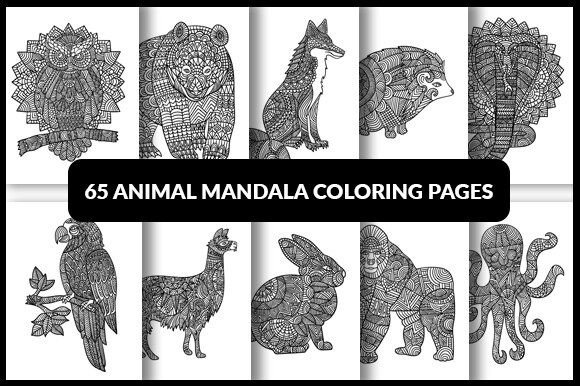
65 Animal Mandala Coloring Pages
When you decide to launch a coloring book on Amazon KDP, ready-to-use interiors like the 65 Animal Mandala Coloring Pages pack feel like a shortcut to creative freedom. The idea of instantly receiving high‑resolution designs in multiple formats, all tested on the platform, is genuinely exciting. But rushing from purchase to upload without a closer look can turn that shortcut into a frustrating detour. Far too many creators treat these bundles as a finished product right out of the zip file, and that assumption quietly undermines print quality, buyer trust, and long‑term profitability. The pack itself is well‑crafted: it gives you 65 intricately drawn animal mandala pages, delivered as JPG, PNG, and a print‑ready PDF in A4 dimensions (8.5×11 inches) at 300 DPI, all perfectly black and white and screened for Kindle Direct Publishing. How you use that foundation, however, decides whether your book becomes a steady seller or a one‑star disappointment.
Why Relying on “Print‑Ready” Without Verification Is a Costly Gamble
One of the most common misunderstandings surrounding a pack called 65 Animal Mandala Coloring Pages is the belief that a PDF described as “ready to upload” needs no further inspection. Sellers of high‑quality interiors do extensive testing, but they cannot predict every trim setting, margin tweak, or printing equipment Amazon’s POD network might use on any given day. If you skip the verification step, you risk grayscale banding inside delicate mandala rings, uneven line weight, or images that get clipped near the spine on a perfect‑bound paperback. A simple pre‑upload ritual solves this: open the PDF in a viewer like Adobe Acrobat, zoom to at least 400%, and scan a few random pages. Look specifically at the thinnest filigree details; if they appear jagged or break apart at extreme magnification, they may reproduce poorly on paper even at 300 DPI. After that, print two or three pages on your home laser printer at actual size. Nothing beats a physical preview. A customer holding a muddy mandala will forget your cover price fast—and their refund request will linger in your account health for weeks.
The Licensing Blind Spot That Can Shut Down Your KDP Journey
An oversight that trips up both beginners and seasoned sellers is reading the product description hurriedly and missing the usage clause. The note that comes with this pack is clear: “You can sell on it only Amazon Kindle Direct Publishing.” Many assume they can also list the same designs on Etsy as printable sheets, create a planner insert, or bundle them inside a paid Canva template. Doing so violates the license terms and can lead to intellectual property complaints. The result is rarely a friendly warning; it is often a permanent suspension of your Amazon account if the complaint originates from the rights holder. Even if you self‑publish only on KDP, double‑check that you do not accidentally use the separate JPG or PNG files to create a low‑content lead magnet on a different platform without written permission. When in doubt, treat the interior as an exclusive tool for your KDP‑published book only. This approach protects both your business and the creator’s rights, and it saves you the distress of waking up to a deactivated account over a well‑intentioned but unauthorized use.
Format Confusion: Picking the Wrong File for Your Workflow
The download gives you JPG, PNG, and PDF files, all at 300 DPI on 8.5×11 inch pages. The availability of multiple formats is a benefit, but it also invites a classic mistake: using individual images instead of the consolidated PDF when you compile your interior. If you drag 65 separate JPGs into your KDP manuscript builder, you introduce the risk of slight sizing inconsistencies, unwanted compression during conversion, or page ordering errors that are hard to spot until the proof arrives. The PDF version was designed as the primary print file; its pages are uniformly sized, and the sequence already respects the flow of a flip‑through experience. Save the JPG and PNG files for marketing purposes—social media previews, mockups, or your author central gallery—where their editable nature shines. For the actual book block, lean on the PDF. A smarter workflow still: open the PDF in a layout program if you plan to insert title pages or blanks, export a fresh PDF, and always run it through Amazon’s online previewer before hitting publish.
Overlooking Bleed and Margins in an 8.5×11-Inch Landscape
A 65‑page animal mandala collection delivered at A4 dimensions (8.5×11 inches) sounds foolproof, but the relationship between your trim size and image placement deserves more attention. Most of these pages are designed to fill the sheet gracefully, yet intricate designs that run right to the edge without proper bleed accommodation can get cropped distractingly during the print run. If the background is pure white and a delicate elephant’s ear touches the bleeding boundary, the trim might slice off a millimeter of the ear, making the artwork feel incomplete. Check whether the PDF includes a bleed allowance. If it does not, and you intend to offer a standard 8.5×11 inch paperback with full‑bleed color (or black‑and‑white) interior, you will need to slightly enlarge the pages or shrink the artwork within a safe zone. A corrective step is to use the 8.5×11 inch format with a small internal margin of at least 0.25 inches on all sides, ensuring no critical motif sits in the danger zone. Communicate this clearly in your bullet points so customers know what to expect.
Assuming All Pages Appeal to Every Animal‑Mandala Buyer
The 65 pages blend animal motifs with mandala geometry, but the style can vary—some pages might feel more whimsical and playful, others carry a meditative, highly repetitive pattern. A mistake many KDP authors make is using the entire pack in a single book without curating a coherent visual story. If your target audience expects a serene, stress‑relief experience, but you include a handful of pages that lean heavily on cartoonish bat wings or over‑the‑top spider webs (a subtle nod to a cute Halloween influence hidden in some designs), those pages can break the mood. Review each page before final assembly. Group the most intricate, calming mandalas at the beginning, and if you choose to keep the quirkier ones, consider adding a themed chapter divider. You are not obligated to use all 65 pages; sometimes a tighter 50‑page book sells better because it feels intentionally curated. The download gives you abundance—your job is to wield it with taste.
Ignoring the Real Limits of Black‑and‑White Reproduction
High‑resolution black‑and‑white files can still fool you on a bright computer screen. The 300 DPI PNG and JPG files might display exquisitely fine details, but when printed on Amazon’s cream or white paper at 600 dpi reproduction, ultra‑thin lines can disappear or lose contrast. This is especially true near the center of a mandala where lines converge. Before finalizing your interior, run a test print on a monochrome setting that mimics the lower paper density of Amazon’s stock. Use a resolution pattern specifically for mandala pages: print a page that has both extremely delicate loops and bold outlines. If the fine lines vanish, you may need to pre‑process the pages by slightly darkening the line art or adding a non‑printing guide layer that you later remove. A simpler alternative is to inform buyers up front that the book is designed for gel pens, fine liners, and colored pencils—not heavy markers that might bleed. Honest communication elevates your product without hiding any limitation.
Skipping the “Real‑Book” Preview on KDP’s Platform
The final and most easily avoided mistake is trusting your PDF’s appearance in a desktop reader without running it through Amazon’s print preview tool. The 65 Animal Mandala Coloring Pages pack has been tested on the KDP platform, but the previewer still checks how your specific upload interacts with your chosen trim size, page count, and paper type. When you load the interior, flip through all 65 pages in the online viewer. Look for pages that may seem squashed or stretched, and verify that left‑right page margins alternate correctly for a two‑page spread. A page that appears centered in the PDF but renders off‑center in the preview often indicates a missing gutter margin; you can fix that by adjusting the interior in a PDF editor to add a subtle shift toward the spine on odd‑numbered pages. The ten minutes you spend in the previewer are worth more than the days of grief a misprinted proof will cause.
Practical Workflow for a Standout Coloring Book
Instead of treating your 65 Animal Mandala Coloring Pages as a push‑button solution, see them as a high‑quality canvas. Start by unzipping the pack and organizing the PNG files into a lightweight folder for your own preview. Use the JPG files to build a mockup with your cover design, seeing how the animal mandala theme translates into a compelling front cover. Then open the PDF and overlay your copyright page, a title page that hints at the whimsical or meditative mood of the collection, and a call‑to‑action page for reviews. Keep the linework consistent; if you add your own graphics, ensure they also maintain the 300 DPI standard and pure black color space. Once satisfied, export a fresh PDF, upload it, and order a physical proof before listing publicly. This staged approach catches every misstep before a buyer ever does.
When Even Great Files Need a Personal Touch
The bundle is comprehensive, but the most successful KDP coloring books don’t stop at the included designs. Consider adding a brief introduction that explains the meaning behind a couple of the animal mandalas—perhaps a fox for cunning or an owl for wisdom. This small editorial layer differentiates your book from dozens of copycat listings. It also aligns with E‑E‑A‑T principles, demonstrating that you have authentic knowledge about the content you published. You might also include a dotted‑line cutting guide if you want to promote the idea of removable pages. Since the source files are black‑and‑white, these additions will not disturb the coloring experience. The goal is to transform a ready‑made interior into a book that feels uniquely yours, even though its artistic foundation was built by a talented designer.
In the end, the value of the 65 Animal Mandala Coloring Pages pack rests not just on its crisp 300 DPI resolution or the convenience of A4 sizing—it rests on your ability to treat it as a raw material rather than a finished product. By checking every line, respecting the license, testing physical prints, and thoughtfully assembling the pages, you turn a common KDP interior into a customer favorite. The animal mandalas themselves, with their meditative symmetry and gentle complexity, will do the heavy lifting once the book is in a buyer’s hands. Your careful preparation ensures that the first impression is one of quality, not regret.