Head to Toe Assessment: A Strategic Framework for Clinical Excellence and Lifelong Learning
In healthcare, information is treatment. Before a single medication is administered or a care plan drafted, a clinician must gather and interpret data with precision. The Head to Toe Assessment is far more than a rote sequence of checks—it is a structured, repeatable system for uncovering subtle changes that alter clinical decisions. For nursing students, seasoned practitioners, and even healthcare-adjacent professionals who value operational clarity, mastering this systematic evaluation is a strategic advantage that compounds over a career.
When approached thoughtfully, the Head to Toe Assessment serves as a decision-making scaffold. It transforms subjective impressions into objective baselines, reduces diagnostic blind spots, and equips you to communicate findings with confidence. The growing availability of high-resolution nursing study sheets, digital checklists, and print-ready physical assessment guides makes it easier than ever to internalize this framework—but only if you use them intentionally, not mechanically.
Why a Systematic Full-Body Evaluation Supports Better Outcomes
Think of a Head to Toe Assessment as a risk-management protocol hidden inside a clinical skill. Without a consistent sequence, even experienced nurses can overlook faint signs—a slight asymmetry in pupil response, a barely audible heart murmur, a pressure injury forming on an overlooked heel. These misses cascade into delayed interventions, extended hospital stays, and preventable complications. The checklist mindset isn't about checking boxes; it's about creating a cognitive safety net that functions when fatigue, interruptions, or cognitive load threaten your attention.
For a nursing student, building this habit early shapes how you process patient data throughout your education and beyond. Instead of memorizing isolated symptoms, you begin to see patterns across systems. You notice, for example, that poor skin turgor during integumentary assessment aligns with low urine output when you reach the genitourinary system. That pattern recognition—the ability to connect a cardiovascular finding to a neurological one—is what elevates a technician into a clinical thinker. High-quality clinical notes and nursing study sheets that are organized by system, not just by body region, accelerate this integrative learning.
The Anatomy of a Practical Head to Toe Assessment Sequence
Strategically, the sequence matters. Most systematic assessments begin with general observation—level of consciousness, apparent distress, skin color—before moving from the head downward. A typical flow might include:
- Neurological and head: Orientation, pupils, facial symmetry, scalp, mucous membranes.
- Neck and upper chest: Carotid pulses, jugular vein distension, trachea position, thyroid.
- Anterior/posterior thorax: Breath sounds, heart sounds (rate, rhythm, murmurs), spinal alignment.
- Abdomen: Inspection, auscultation before percussion/palpation, bowel sounds, tenderness.
- Extremities: Pulses, capillary refill, edema, sensation, range of motion, skin integrity.
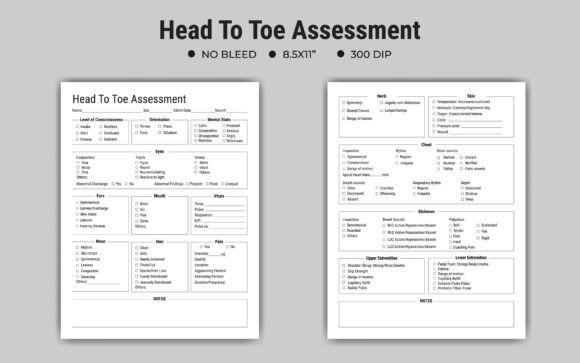
Each step builds on the previous one, reducing the chance that a distracted assessor will forget to listen for bruits after checking for abdominal distension. When you use a Head to Toe Assessment checklist card or a well-designed digital download PDF, the visual hierarchy reinforces that logical flow. A card that's sized for a clipboard or pocket—like an 8.5″ × 11″ print-ready file—turns into a portable cognitive scaffold, particularly during clinical rotations or in fast-paced environments where you're still internalizing the sequence.
Combining Study Tools with Deliberate Practice
Owning a 120-page physical assessment reference or a bundle of JPG and PDF files isn't enough. The learners who gain the most treat these resources not as passive notes but as active rehearsal partners. Here's a practical approach: take a Head to Toe Assessment guide and transcribe its key prompts onto blank paper in your own shorthand, then perform a timed practice assessment on a study partner or manikin without looking. Only afterward do you compare your sequence to the structured template. That retrieval practice, paired with rapid feedback from a high-resolution visual reference, strengthens neural pathways faster than re-reading a list for the fourth time.
Entrepreneurs and high-performing professionals often speak of systems and checklists; a 300 dpi nursing study sheet that's crisp, visually clean, and logically organized is no different from a pre-flight checklist used by pilots. Both reduce reliance on working memory under pressure. Both are especially valuable during transitional periods—when a new graduate nurse precepts on a busy unit, or when a practitioner returns after an absence. The strategic move is to curate your own set of resources: maybe a comprehensive 120-page interior for deep study and a one-page checklist card for shift reference. Digital files make this customization easy; you can print only the pages you need, mark them up, and reprint as your competence grows.
When to Perform a Head to Toe Assessment—and When Not To
Context matters more than rigid protocol. A full Head to Toe Assessment is appropriate at the start of a shift, upon admission, after a significant change in status, or post-procedure. But performing every element on a stable, long-term care resident every four hours wastes time and can erode trust if it feels robotic. Strategic clinicians adapt depth to purpose. A focused cardiac assessment might take two minutes; a complete physical examination, twenty. Understanding this spectrum keeps you from burning through mental energy on low-yield repetition.
Consider creating a personal decision matrix: If the patient is newly admitted and elderly with multiple comorbidities, a full head-to-toe establishes an essential baseline. If they are a young, healthy post-operative day two patient with stable vitals, a targeted reassessment of surgical site, lungs, and mobility may be adequate. The Head to Toe Assessment framework remains the reference; you simply scale it up or down based on clinical need. This approach mirrors how business owners use a full audit versus a quick dashboard—the structure is always there, but you deploy it wisely.
Risks of a Checklist-Only Mindset
One overlooked danger is treating the Head to Toe Assessment as purely transactional. When students rely solely on a print-ready checklist without understanding why each step exists, assessment becomes a perfunctory ritual. They may listen to lung fields but fail to recognize diminished breath sounds as a signal of atelectasis. They palpate pedal pulses but miss that weak, thready pulses accompanied by cool skin demand immediate escalation. The checklist is a memory aid, not a replacement for clinical reasoning.
To avoid this, use your fundamentals of nursing resources to dig into normal and abnormal findings. Pair the checklist with a high-quality clinical notes system where you document not just presence or absence but characteristics: "lungs clear to auscultation bilaterally, no crackles" is better than a checkmark. "Radial pulses 2+ and equal, capillary refill less than 3 seconds" conveys clinical judgment. Gradually, the checklist transitions from a crutch into a launchpad for deeper observation.
Designing a Learning System that Grows with You
Your study materials should evolve. A nursing student might start with a 120-page interior PDF that explains every body system in detail, including illustrations and common pathologies. As they approach graduation, they compress that knowledge into a concise Head to Toe Assessment checklist card—perhaps a single sheet designed precisely at 8.5″ × 11″, with no bleed, optimized for quick visual scanning. Later, as a preceptor or educator, they might pull from those same digital files to create teaching aids. The asset isn't just a static product; it's a flexible resource that supports your career trajectory.
When selecting a digital download, look for high-resolution (300 dpi) files that remain crisp when printed at home or through a professional service. A product tested on platforms like Amazon KDP suggests the layout is clean and printer-friendly—important if you intend to run multiple copies or share with a study group. Vector illustrations of medical concepts, organized templates, and logically sequenced sections save you hours of formatting. Your time shifts from designing the tool to using it deliberately.
From Individual Assessments to Systemic Impact
Mastering the Head to Toe Assessment doesn't just improve individual patient interactions. It elevates team communication. When a nurse presents a concise, system-by-system report during rounds, the entire care team makes faster, better-informed decisions. That nurse builds a reputation for reliability and thoroughness—traits that open doors to leadership roles, specialized units, and educator positions. In a profession facing staffing challenges, the clinicians who can efficiently collect and transmit accurate data are the ones who soon find themselves mentoring others and shaping unit culture.
There's also a quiet confidence that comes from knowing you haven't missed something obvious. Whether you're a new graduate facing your first independent patient assignment or an experienced practitioner covering a high-acuity floor, that confidence reduces anxiety and allows you to focus on the human connection—talking to the patient, explaining findings, building trust. The technical skill supports the relational one. And that's a strategic insight often missing from purely task-oriented training.
Selecting and Using Your Head to Toe Assessment Resources Intentionally
If you decide to invest in a Head to Toe Assessment guide, whether a comprehensive nursing study sheets bundle or a single-page physical assessment card, approach it with a clear goal. Are you preparing for OSCEs and need a structured review tool? Do you want something to keep in your scrub pocket during clinicals? Are you building a reference library to support a study group? Different formats serve different purposes. A 120-page PDF gives you depth; a 1-page JPG gives you speed. Having both allows you to match the tool to the learning moment.
Treat the purchase not as an endpoint but as the start of a deliberate practice cycle. Set a schedule: review one body system per week using the detailed notes, then perform that component on every patient you encounter that week, comparing your findings to the expected range. Document your observations in a structured clinical notes format. Over three months, you'll have internalized the entire sequence without the overwhelm of cramming. The files become a permanent reference you can return to when you encounter an uncommon condition or need to refresh before a competency review.
Long-Term Value Beyond the Classroom
For the nurse entrepreneur creating educational content, the Head to Toe Assessment represents a content pillar with consistent demand. High-quality nursing study sheets and clinical notes templates sell not because of novelty but because of clarity and reliability. A product that's been tested on Amazon KDP, with the correct trim size (8.5″ × 11″), no bleed, and 300 dpi resolution, signals professionalism. Buyers—often adult learners balancing work and study—want resources that work the first time, without reformatting or scrambling for printing adjustments.
Similarly, for bloggers and publishers in the healthcare education space, an article that thoroughly explores the Head to Toe Assessment can serve as a foundational piece that ranks for long-tail keywords around nursing fundamentals, clinical checklists, and physical assessment tools. The key is to provide genuine, experience-backed insights rather than superficial fluff. This not only satisfies search intent but builds trust with readers who may later purchase linked resources or enroll in courses.
Ultimately, the Head to Toe Assessment is a microcosm of good clinical practice: disciplined, patient-centered, and intellectually honest. Whether you're learning it for the first time, teaching it to others, or building a product around it, the principles remain the same—structure creates freedom, checklists enable creativity, and systematic thinking produces better results than ad-hoc effort. Invest in understanding the "why" behind each step, pick tools that align with your learning or professional stage, and apply the framework with the adaptable rigor it deserves. The payoff is not just passing an exam or avoiding a missed finding; it's building the kind of clinical intuition that transforms a transaction into genuine care.