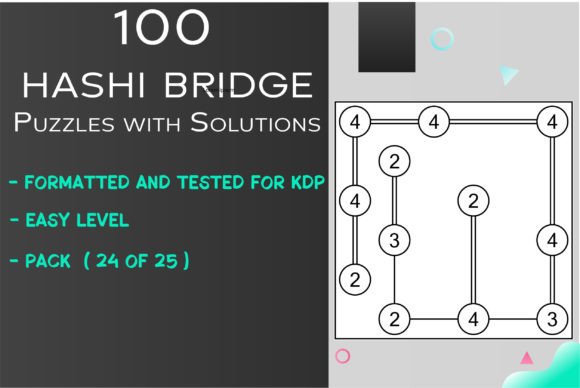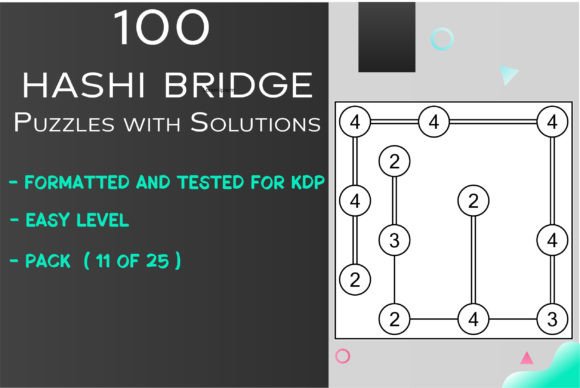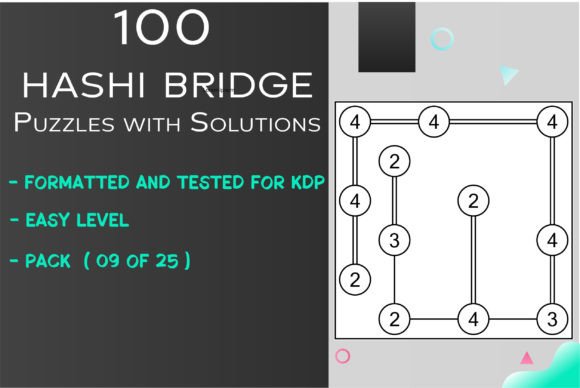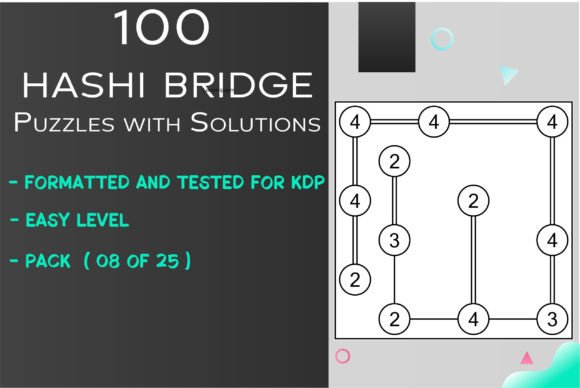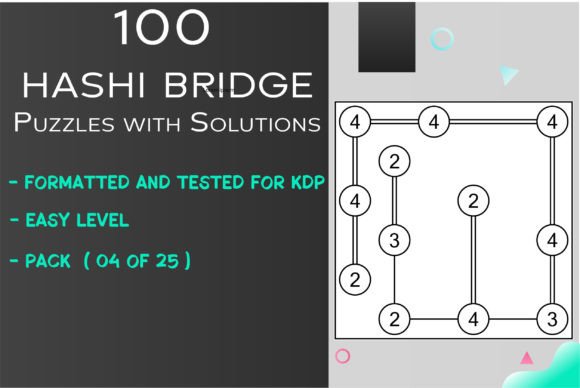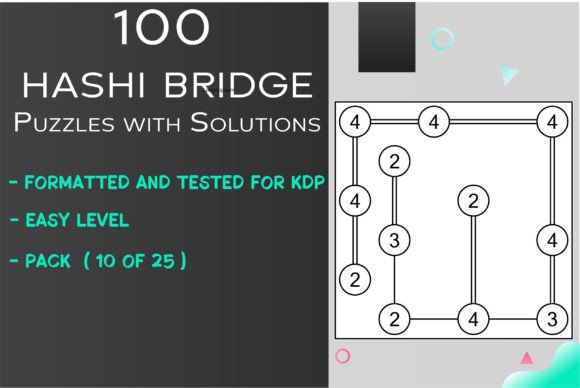
100 Easy Hashi Bridge Puzzles 10 of 25
This collection brings together one hundred Hashi puzzles, all set on a 6×6 grid and tuned to an easy difficulty level. It arrives as the tenth volume in a longer series of twenty-five, so you can think of it as a reliable stop on a much bigger journey. Whether you solve them for pleasure, teach logic with them, or publish them as part of a book, the files adapt to your process instead of asking you to work around them.
Every puzzle includes its solution, and the download provides four open‑ended formats: EPS, PNG, JPG, and SVG. That might sound technical, but the real point is flexibility. One person’s print layout is another person’s digital screen is another person’s editable template, and the collection does not force a single path.
A manageable size for calm focus
Hashi — short for Hashiwokakero — asks you to connect numbered islands with the correct number of bridges. At a grid size of 6×6 and an easy difficulty, these puzzles remove the overwhelming “where do I even start” feeling that often stops newcomers. The logic stays clear, the patterns repeat just enough to build confidence, and no single puzzle expects you to hold five threads in your head at once.
For adults who want to unplug after work, a single puzzle might take a few minutes and provide a small sense of accomplishment. Hobbyists who enjoy mindful activities often compare sets like this to colouring books — predictable enough to relax you, varied enough to keep the mind awake. If you are new to Hashi, starting here builds the visual intuition that harder grids demand later.
Why KDP publishers approach this set differently
Publishers look at a puzzle collection through a commercial lens, and the priorities shift. They ask: Is it print‑ready? Can I customise it? Does it fit a series? Volume ten of twenty‑five matters here because a series helps buyers recognise your brand. If a customer picks up one volume and enjoys the gentle difficulty, they have a clear path to grab earlier or later editions. That repeat engagement supports reader loyalty and can stabilise royalties over time.
The included EPS and SVG files mean a publisher can open the puzzles in vector software, tweak line weights, adjust fonts, or rearrange grids to match an interior style guide. PNG and JPG rasters serve rapid previews, placeholder insertion, or a quick‑and‑tidy photo book. Because the collection is designed for KDP, the dimensions already keep an eye on standard trim sizes, and the high‑resolution output stays crisp on 300 dpi printing. A publisher doesn ’t need to redraw a single island.
Small business owners who sell activity books at craft fairs or on their own sites might take a different route: print selected PNG pages, bind them on demand, and test local demand before committing to an ISBN.
For the designer who treats puzzles as raw material
Creatives and designers often see a puzzle collection not as an end product but as a starting layer. The file formats here change what is possible. An SVG file, for instance, can be dropped into a layout tool and recoloured to match a brand palette. A designer building a weekly newsletter might include a single puzzle as a footer feature, adjusting the grid colour to complement the email background. An EPS file can be resized for a large poster without losing sharpness — imagine a classroom wall display, or a café activity sheet where the puzzle sits next to custom illustrations.
This granular control matters when you want the puzzle to feel like yours, not like a clip‑art insert. Educators, similarly, might take the JPGs and embed them into slide decks or printable worksheets, adding a border or a hint section that fits the lesson pace. The constraint of “easy” difficulty becomes a strength here: the puzzle doesn’t demand too much attention from the rest of the page.
Real examples across different user paths
Consider a freelance blogger who writes about brain training for busy professionals. They could grab a single puzzle from the set, attach a short solving tip, and publish a weekly “mindful break” post. Because the files are already organised, they save the thirty minutes usually spent hunting for a usable, rights‑clear puzzle.
A maths tutor teaching basic deduction might print three puzzles on a single sheet, hand them out at the start of a session, and use the simple logic to warm up students for more abstract problem‑solving. The consistent grid size means every session starts with familiar territory.
A retiree who discovered puzzle books during the early months of the pandemic might not care about formats at all — they just want to print the pages and solve with a pen at the kitchen table. For them, the value sits squarely in the volume: one hundred puzzles can last months if approached slowly.
Entrepreneurs building an app prototype sometimes test logic‑game concepts with static puzzles before coding the algorithms. They might use the SVG files to pop into a wireframe and gauge user feedback on visual clarity. The easy level ensures the test participants focus on the app interface, not on struggling with a hard puzzle.
Flexibility without hidden complexity
Collections that offer multiple file formats sometimes bury the user in options. Here, the choices are clearly separated. You receive a folder of EPS files for deep editing, a folder of SVGs for scalable but lighter editing, and raster folders of PNG and JPG for immediate use. No special reader software is needed to sort them. That straightforwardness appeals to anyone whose patience for file management has worn thin.
Hobbyists who just want to scroll and solve on a tablet can keep the JPGs in a gallery app. Graphic‑savvy users can open the EPS and push the layout further. Both paths exist without interfering with each other. The set does not assume a single skill level; it just provides the ingredients and says, “Do what you need.”
Long‑term usefulness beyond one project
A single purchase can fold into multiple projects over several years. A book creator might use the puzzles in a single‑volume paperback today, then later repurpose cleaned‑up SVGs for a series of themed puzzle calendars. Because volume ten is part of a larger series, the creator can return to the same source for volume eleven, twelve, and onward, keeping the style consistent while the content remains fresh.
For educators, the set acts as a reusable library. When one academic year ends, the same puzzles can appear in a new context — maybe a summer bridge activity booklet or a quiet‑time station in a mixed‑age classroom. The easy difficulty stays appropriate for a wide age span, so the shelf life feels generous.
Customers who prize reliability and long‑form engagement often find that puzzle sets with a clear difficulty label and a series number earn more trust than anonymous, one‑off downloads. Knowing it is “10 of 25” gives a sense of place, and the consistent grid size across the series means you can recommend any volume without worrying that difficulty suddenly jumps.
Does this match your own goals?
Think about what you actually need. If your priority is speed — get a puzzle book on Amazon within the week — the pre‑solved, press‑ready structure saves you from creating solution pages from scratch. If your focus is creative control, the vector files open that door without forcing you to redraw anything. If you simply want a quiet, satisfying puzzle experience, the gentle difficulty and generous count will carry you for a long while.
On the other hand, if you need high‑difficulty challenges for seasoned solvers, this easy‑level volume won’t scratch that itch — though it might still serve as a warm‑up section inside a larger publication. Matching the resource to the intent prevents frustration, and one of the quiet strengths of a well‑labelled series is that it helps you self‑select.
Ultimately, 100 Easy Hashi Bridge Puzzles 10 of 25 stands out not for a single flashy feature but because it meets different people where they are. The puzzle lover gets a slow, steady supply. The publisher gets a reliable, editable asset. The teacher gets a ready‑made logic exercise. And everyone gets the quiet satisfaction of knowing the bridges connect exactly where they should.